
4 min read
Best Home Office Storage Solutions (Costs, Ideas & Custom Options)
Home Office Storage Solutions for Remote Workers: Stay Organized from 9 to 5 Updated April 2026 Are you constantly fighting clutter in your home...
6 min read
Most garages are asked to do too many things at once: park the car, hold the holiday decorations, store the lawn equipment, and somehow also function as a place to tackle projects. The result is usually a space where nothing works well, and everything feels chaotic.
The good news? A garage that handles both serious storage and a functional workshop is completely achievable. After designing custom home storage solutions for over 25 years, we know this is possible with a little planning upfront.
In this article, we’ll walk you through how to split your garage into zones, how to decide which storage system works best for your lifestyle, and how to incorporate a workshop into your garage, so you can stop fighting clutter and start enjoying every square foot of your home.
.png?width=1200&height=680&name=How%20to%20Design%20a%20Garage%20for%20Both%20Storage%20and%20a%20Workshop%20(2).png)
The single most important move in a dual-purpose garage is zoning. Before you buy a single shelf or workbench, decide which areas of the garage belong to which function.
A common and effective approach is to divide the space along the walls versus the floor. Walls are your storage real estate. The floor space near a window or an exterior outlet becomes your workshop zone. Traffic flow matters too: you want to be able to move between your car, around your storage, and your work area without navigating an obstacle course every time.
Consider where your overhead door is, and where the entry door is, if there are any windows, and where your electrical panel is located. Those fixed points will shape everything else.
For most two-car garages, one bay can handle parking, while the other serves as the primary work and storage area. In a single-car garage, you may need to be more creative with vertical storage to preserve floor space for your workshop.

Once you know your zones, the storage side of your garage needs a system that actually holds what you have without eating up the square footage you need for working.
Slatwall panels are one of the most flexible options for garage walls. They accept hooks, baskets, shelves, and specialized holders in any configuration, and that configuration can change as your needs do. They work especially well for hand tools, garden equipment, sports gear, and anything you want visible and accessible at arm's reach.
Overhead storage racks are worth serious consideration for anything you use seasonally: holiday bins, camping gear, luggage, ski equipment. Getting that category off your floor and ceiling-adjacent opens up a remarkable amount of usable space below.
Cabinets along one wall give you enclosed storage for chemicals, paints, automotive supplies, and anything you want protected from dust (which workshops tend to generate). Closed cabinet doors also just make the space feel calmer and more organized.
The key question to ask yourself: what do you need to reach every day, what do you need monthly, and what do you need once or twice a year? Those three tiers should live in three different kinds of storage.
.png?width=1200&height=680&name=How%20to%20Design%20a%20Garage%20for%20Both%20Storage%20and%20a%20Workshop%20(1).png)
Your garage workshop area needs three things to function well: a solid surface to work on, proper lighting, and accessible tool storage.
For the work surface, a sturdy workbench along one wall is the foundation. The height matters more than most people realize. Standard workbench height runs around 34 to 36 inches, but if you do a lot of detail work, you may want something closer to counter height. If you do heavy assembly or use power tools that generate vibration, you want something low enough that your elbows can comfortably bear down.
Lighting in a garage workshop is frequently underestimated. Overhead LED shop lights are a significant upgrade from a single bulb and are worth every penny when you're trying to measure accurately or work safely with power tools. Add a task light directly over your bench if possible.
For tool storage in the workshop zone, a combination of slatwall above the bench and a few deep drawers or a rolling tool chest below keeps your most-used tools accessible and organized. The goal is never to have to leave your workspace to find what you're looking for.
Your garage floor takes a beating: dropped tools, rolling equipment, oil drips, sawdust, and foot traffic. The right flooring makes the whole space more functional and more comfortable to spend time in.
Epoxy-coated concrete is one of the most popular options for good reason. It's durable, easy to clean, stain-resistant, and gives the garage a finished look that makes the whole space feel more intentional. It does require proper prep work before application.
Interlocking rubber or PVC floor tiles are a more DIY-friendly option and can be installed in sections, which is helpful if you want different flooring in your workshop zone versus your parking area. They're also easier on your legs and feet during long projects.
Anti-fatigue mats in your specific workshop zone are worth adding, regardless of your base flooring. Standing on concrete for two or three hours without cushioning wears on your body more than most people expect until they've experienced the alternative.
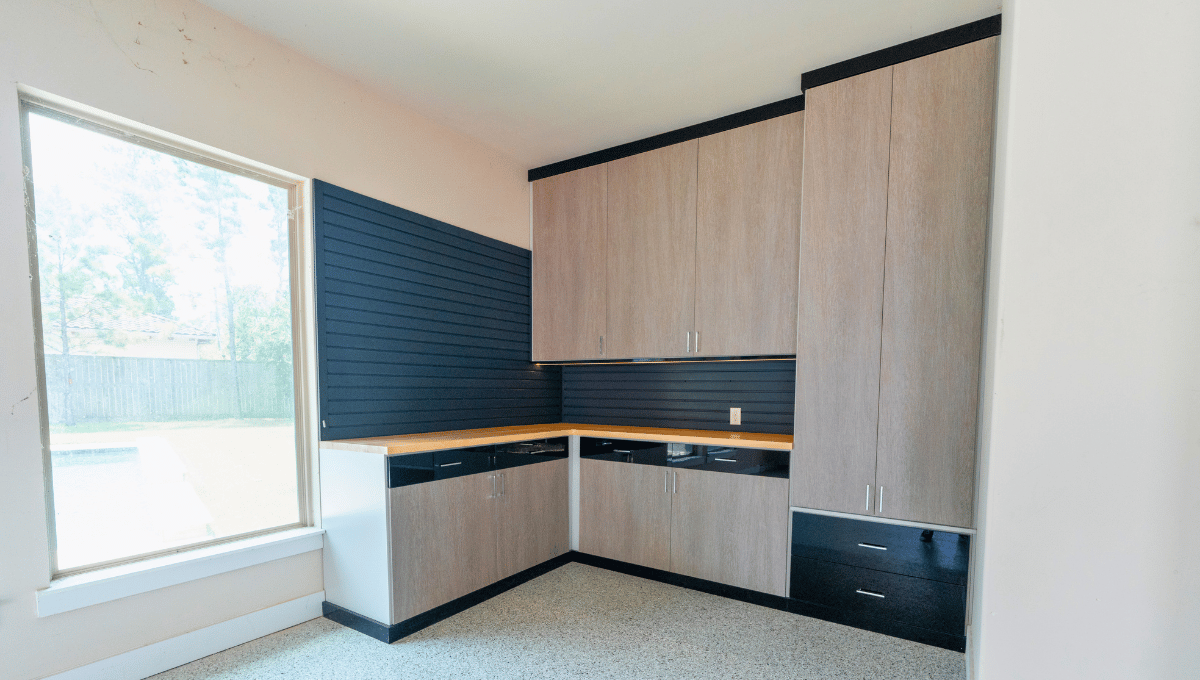
Walls are the most underused square footage in almost every garage. From floor to ceiling, a 20-foot wall can hold an enormous amount if it's set up correctly.
A few principles that make a real difference:
A garage that works for both storage and a workshop isn't about having the biggest space. It's about being intentional with the space you have.
The homeowners who end up loving their garages are the ones who planned the layout before buying the shelving, chose storage systems that actually fit what they own, and gave their workshop area the same thoughtfulness they'd give any other room in the house.
If you're not sure where to start, schedule your free in-home design consultation today.
Our designers have helped hundreds of Houston-area homeowners turn cluttered, frustrating garages into spaces they genuinely enjoy spending time in. We'd love to do the same for you.
How much does it cost to organize a garage with both storage and a workshop?
Garage organization costs vary based on garage size, the storage systems selected, and the level of customization. Basic setups with slatwall and shelving can start in the low thousands, while fully custom systems with cabinets, overhead racks, and a built-in workbench run higher depending on square footage and materials. A free in-home design consultation with SpaceManager Closets gives Houston homeowners an accurate estimate based on their specific space and goals.
Do I need a permit to add a workbench or storage to my garage?
In most cases, no permit is required to add a workbench, slatwall panels, cabinets, or overhead storage racks to a garage in the Houston area. These are considered personal property improvements. However, adding new electrical outlets or upgrading a panel to support power tools does require a licensed electrician and a permit. Homeowners should verify requirements with their local municipality before beginning any electrical work.
How much space do I need for a functional garage workshop?
A functional garage workshop can be set up in as little as 100 square feet, roughly a 10x10 area, when storage is organized vertically and the workbench runs along a wall. In a standard two-car garage, one bay can be dedicated to parking while the other handles both storage and a workshop. Efficient zoning matters more than total garage size.
What is the best way to store large power tools in a garage?
Mobile bases are the most practical solution for large stationary power tools such as table saws, band saws, and drill presses. A mobile base allows the tool to be rolled into the work zone during use and stored out of the way when not needed. Smaller power tools are best kept in deep cabinets or dedicated drawer systems to protect them from dust and keep them accessible.
How do I keep workshop dust and mess from spreading to garage storage areas?
Clear physical zoning between the workshop area and the storage area is the most effective way to contain dust and debris. Enclosed cabinets on the storage side protect belongings better than open shelving. A shop vacuum with a long hose positioned in the workshop zone makes routine cleanup faster and prevents sawdust from settling on stored items.
Can a garage be designed for both storage and a workshop at the same time?
Yes. A garage can be fully optimized for both storage and workshop functions when the layout is planned intentionally. The approach involves dividing the space into defined zones, selecting storage systems that work vertically to preserve floor space, and building a dedicated workshop area with a proper workbench, lighting, and tool storage. SpaceManager Closets designs fully custom garage solutions for Houston-area homeowners that incorporate both functions, starting with a free in-home consultation.
4 min read
Home Office Storage Solutions for Remote Workers: Stay Organized from 9 to 5 Updated April 2026 Are you constantly fighting clutter in your home...
5 min read
Quick Answer: The best way to maximize garage storage when you have limited wall space is to build upward instead of outward, design around your...
3 min read
How to Choose the Best Home Office Storage Solutions for Your Needs Updated April 2026 Is Your Home Office Cluttered and Slowing You Down? Is your...