
5 min read
How to Create a Snack Station for Kids in a Pantry
In the blink of an eye, summer has come and gone, another school year has kicked off, and the messy pantry you promised yourself you would organize...
5 min read
Quick answer: the key to organizing a small pantry with a custom storage system is to use vertical space and create dedicated zones for specific items with accessories, drawers, and racks tailored to how you shop and cook.
If you have ever stood in front of your pantry trying to find a can of diced tomatoes you know is in there somewhere, give up the search so you can make a frustrating trip to the grocery store, only to come home and find the elusive can of diced tomatoes after you’re done cooking, then you already understand how frustrating a disorganized pantry can be.
The problem with your small pantry isn’t that it has too much stuff in it; the issue is a layout that wastes vertical storage space and has no built-in system to keep you organized.
For homeowners across the Greater Houston area, small pantries are one of the most common kitchen frustrations we hear about. The good news is that a small footprint is not a dead end. With the right layout, a compact pantry can hold more, look better, and function like a much bigger space.
In this article, we’ll walk through some of the most common complaints we hear about small pantries, the best way to organize a small pantry and maximize storage space, and discuss top-rated custom features like pull-out drawers, so you can confidently create your own custom pantry storage system.
.png?width=1200&height=680&name=How%20to%20Organize%20Small%20Pantry%20Custom%20Storage%20(1).png)
If you find yourself reorganizing the same pantry every few months, the layout is usually the real issue, not your habits. Wire shelving, single deep shelves, or a few adjustable boards were never designed around how you actually shop and cook. They were designed to be inexpensive to install.
A few common culprits:
Once the layout is fixed, the mess tends to fix itself. That is the whole idea behind a custom pantry system, designed around your specific space and how your household uses it.

Start by grouping items into categories before you think about shelving at all. Most households land on some version of these zones:
Once you know your zones, the layout question becomes much easier to answer. A small pantry usually benefits from:
If you have already compared shelving styles, our recent article on pull-out shelves versus fixed shelves breaks down which option works best for different pantry depths and budgets.
.png?width=1200&height=680&name=How%20to%20Organize%20Small%20Pantry%20Custom%20Storage%20(2).png)
Yes, and this is one of the most common upgrades homeowners ask us about. In a small pantry, depth is often your biggest enemy. A shelf that is 16 to 20 inches deep sounds useful, but anything stored more than a few inches back tends to get forgotten.
Pull-out shelves solve this by bringing the entire shelf forward to you, instead of asking you to reach in and dig around. This matters most for:
Fixed shelves still have a place in a well-designed pantry, particularly for lightweight items or backstock you access less often. The right system usually blends both, rather than choosing one over the other for the whole space.
Walk-in pantries feel like a luxury, but a poorly planned one can actually store less than a well-designed reach-in closet. The fix is almost always vertical planning and full use of wall space, including areas that get overlooked, like the wall behind the door.
For a full breakdown of layout strategies, check out how to maximize a small walk-in pantry, which covers shelving height, door storage, and how to handle awkward corners.
Not every upgrade is worth the investment in a small space. A few features consistently make the biggest impact for Houston homeowners we work with:
Adjustable shelving. Your storage needs change over time, whether that is a growing family, a new appliance, or a shift in how you cook. Shelving that adjusts in small increments lets the pantry evolve with you instead of becoming outdated.
Pull-out drawers and baskets. These bring contents forward and make it easy to see everything at a glance, which is especially valuable in pantries with limited width.
Door-mounted racks. The back of a pantry door is often wasted space. Slim racks here can hold spices, small jars, or cleaning supplies without taking up shelf depth.
Lighting. A dark pantry hides clutter and makes it harder to find what you need. Even simple LED strip lighting under shelves makes a small pantry feel more usable and organized.
Labeling systems built into the design. Built-in label holders or a consistent bin system keep things tidy long after the initial organizing push.
Pricing depends on the size of the pantry, the materials chosen, and how many features like pull-outs, drawers, or specialty accessories are included. Every pantry we design is fully custom, so costs vary from project to project rather than following a fixed price list.
The most accurate way to get pricing for your specific space is a free in-home design consultation. One of our designers will measure your pantry, talk through how you use the space, and put together options based on your goals and budget, with no pressure to commit.
This is a fair question, especially if the space itself feels too small to justify a bigger investment. In practice, small pantries are often where a custom system makes the most noticeable difference. There is very little margin for wasted space, so every shelf height, drawer, and inch of depth needs to work hard. A generic shelving kit rarely accounts for the specific dimensions of your closet, the height of your ceiling, or how your family actually shops and cooks.
A custom pantry is built around your exact measurements and habits, not a standard size that happens to be close enough. For a small pantry, that precision is often the difference between a space that stays organized and one that slides back into chaos within a few weeks.
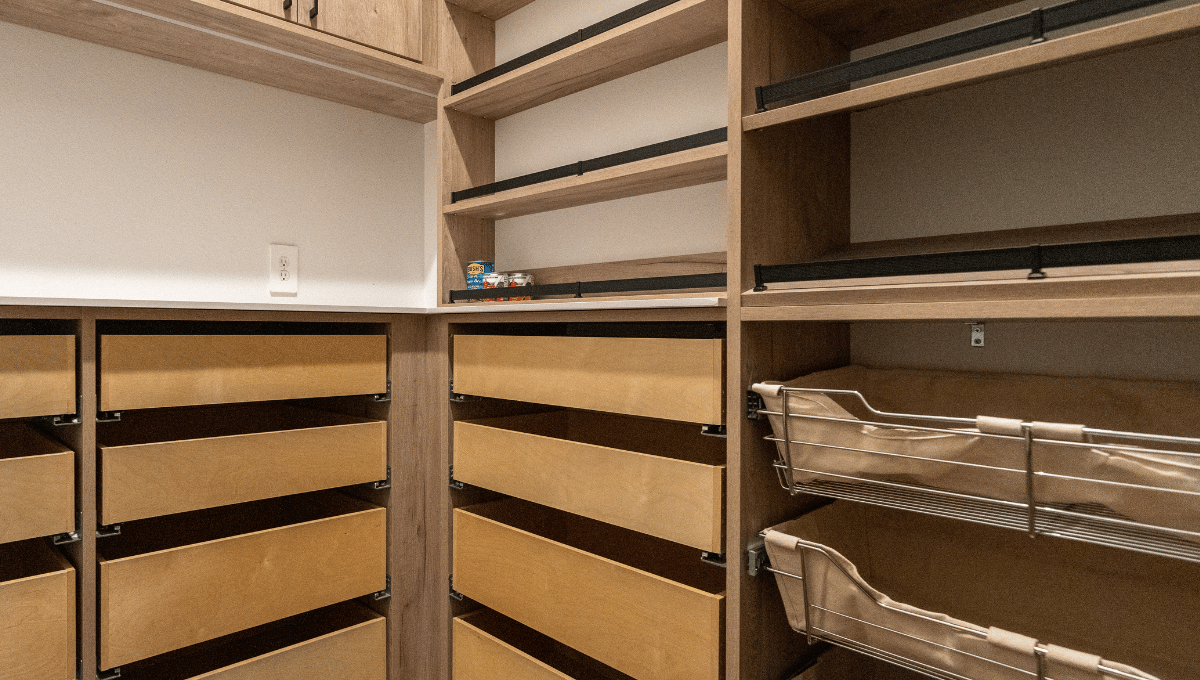
Every kitchen and every household is a little different, whether you are working with a narrow reach-in pantry in a Montrose townhome, a walk-in pantry in a Sugar Land new build, or an awkward closet layout in an older Bellaire home. The best next step is seeing your specific space through a designer's eyes.
To get started, schedule your free-in home design consultation. One of our designers will come to your home, take precise measurements of the space, discuss what's currently not working, and put together a free custom 3D rendering of your improved pantry, so you can see exactly what you're getting without any pressure to commit.
How small is too small for a custom pantry system? There is not really a minimum size. Even narrow reach-in pantries benefit from adjustable shelving, pull-outs, and better use of door and vertical space. Custom design means the system is built to fit whatever footprint you have.
Can I add pull-out shelves to an existing pantry, or do I need to start over? In many cases, pull-out shelves and other features can be added to an existing layout without a full remodel. A design consultation is the best way to find out what will work with your current pantry.
How long does a pantry storage project usually take? Timelines vary depending on the scope of the project and the products selected. Your designer will walk you through an estimated timeline during your consultation based on your specific pantry.
Do I need to empty my pantry before a design consultation? No. Our designers are used to measuring and assessing pantries as they are. It can help to have a general sense of what you want to store, but a full cleanout is not necessary before your appointment.
5 min read
In the blink of an eye, summer has come and gone, another school year has kicked off, and the messy pantry you promised yourself you would organize...
8 min read
The Quick Answer: The best garage storage layout for a Houston home uses a perimeter zone system: closed cabinets along the back wall for...
5 min read
There's something about a room lined with books that makes a home feel truly lived in. Not just decorated, but lived-in and cherished. A space that...