
1 min read
How Deep Should Shelves Be?
Shelving plays an important role in keeping your home organized, but not all shelves are created equal. The depth of a shelf can greatly affect how...
5 min read
If you're upgrading your kitchen storage and are stuck wondering whether to add pull-out pantry shelves or stick with traditional fixed shelves, we’ll save you time debating because the reality is most thoughtfully designed pantries use both. The real question isn't which option is best overall; it's which shelves in your pantry should pull out and which ones need to stay put.
After more than 25 years of designing custom home storage solutions across Greater Houston, we’ve found that a mix of both fixed and pull-out pantry shelves usually provides the functional storage and organization homeowners need. The exact amount and combination of fixed and pull-out pantry shelves varies depending on the space, though it’s generally based on how deep the pantry is, the kitchen layout, what’s being stored, and who's using it.
In this article, we'll walk through the differences between fixed and pull-out pantry shelves, including design, durability, and cost questions, like whether or not pull out shelves are worth it, so you can confidently transform your pantry into the clutter-free space you deserve.
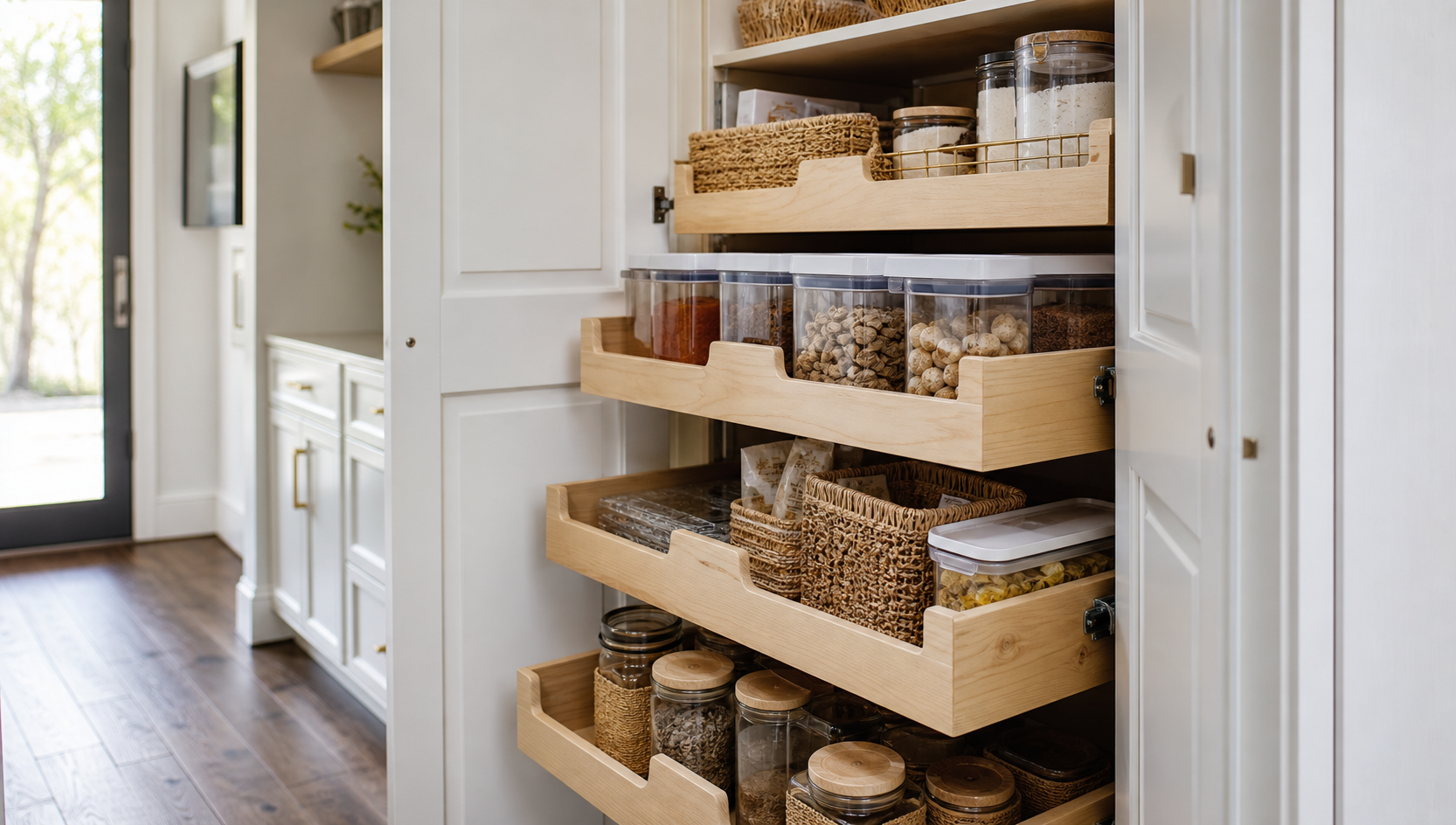
The short answer: Fixed shelves are stationary shelves mounted directly to the pantry wall or cabinet frame. Pull-out shelves, sometimes called roll-out shelves or pantry drawers, glide forward on drawer slides so you can access the entire shelf without reaching into the pantry.
Fixed shelves are simpler, more affordable, and have no moving parts to maintain. Pull-out shelves cost more upfront because of the hardware and labor involved, but they solve a problem fixed shelves can't: reaching items stored toward the back of a deep cabinet or pantry.

While there’s no right or wrong answer, most homeowners who opted to add pull-out shelves to their custom pantry design are satisfied with their decision years later.
Pull-out shelves are worth it in pantries deeper than about 16 to 18 inches, in lower cabinets where bending and reaching is uncomfortable, and in households where small items get lost or forgotten toward the back of a shelf. If you've ever pulled a can of tomatoes from the back of your pantry and found three more behind it you'd forgotten about, that's exactly the problem pull-outs solve.
They're also a strong fit for homeowners planning to stay in their home long term. Full-extension shelving reduces bending and reaching, which matters more with each passing year, and it's a detail we see requested often by homeowners in established neighborhoods like Bellaire and West University who are remodeling for the long haul rather than a quick resale.
.png?width=1200&height=680&name=Pull-Out%20Pantry%20Shelves%20vs.%20Fixed%20Shelves%20(1).png)
Fixed shelves make more sense for shallow pantries, for items you can see and reach without pulling anything forward, and for storage that doesn't need to be accessed often. Think cereal boxes, cookbooks, decorative items, or bulk paper goods stored up high. There's simply no functional benefit to a pull-out mechanism if you can already see and grab what you need.
Fixed shelving is also the barrier to entry, since it skips the hardware and labor cost of slides entirely. For pantries with renovation constraints, using fixed shelves in zones where they make sense and reserving pull-outs for zones that truly need them is typically a solid game plan for managing cost expectations.
As a general guideline, pull-out shelves start to earn their keep once a pantry or cabinet is deeper than 16 to 18 inches. In a shallower space, everything on the shelf is already within easy reach, so a pull-out mechanism adds cost without adding much usable benefit. In deeper pantries, especially reach-in pantries closer to 24 inches deep, pull-outs can be the difference between a pantry that actually gets used efficiently and one where half the space becomes a black hole for forgotten items.
This is one of the details that's hard to judge accurately from measurements alone, which is why we walk every homeowner through their actual pantry dimensions during a free in-home design consultation rather than guessing from a floor plan.
Walk-in pantries generally do well with a mix that leans toward fixed perimeter shelving, since you can physically step inside and see everything, paired with a few strategic pull-outs for heavier items or awkward corners. Reach-in pantries, which you access from the front only, benefit more from pull-outs throughout, since there's no walking around to the back to grab what you need.
We see this play out differently depending on the home. Newer construction in Cypress and Katy often includes larger walk-in pantries where a mostly fixed layout with a couple of pull-out drawers for small appliances works beautifully. Older homes in neighborhoods like River Oaks and Montrose more often have narrower reach-in pantry closets, where pull-outs do more of the heavy lifting to make the depth usable.
.png?width=1200&height=680&name=Pull-Out%20Pantry%20Shelves%20vs.%20Fixed%20Shelves%20(2).png)
Yes, and for most pantries, mixing the two is the best approach rather than an exception. A practical way to think about it is zoning your pantry by how often you use each area and how deep it is:
This is exactly the kind of layout decision that benefits from seeing your space in person and in 3D before committing to a plan, which is what our free in-home design consultation is for.
Custom butler's pantries tend to be smaller and more visible than a walk-in kitchen pantry, often connecting your kitchen to a dining room in homes throughout Sugar Land, The Woodlands, and Pearland. Because they're on display, many homeowners lean toward fixed, open shelving for glassware, serveware, and coffee stations, with one or two pull-out drawers reserved for trays, linens, or small appliances that don't need to be seen.
Weight capacity depends entirely on the slide hardware, not just the shelf material. Full-extension, ball-bearing slides used in custom cabinetry typically hold significantly more than the basic slides found in big-box or semi-custom shelving systems. Because our cabinetry is built locally at our Houston showroom and manufacturing facility, we have the capability to match the slide hardware to what you actually plan to store, rather than defaulting to a one-size-fits-all shelf.
There's no universal winner between pull-out and fixed pantry shelves, because the right pantry isn't built around a single shelving style; it's built around how you actually cook, shop, and store food. The homeowners who end up happiest with their pantry are those who utilized intentional zones with a mix of fixed and pull-out shelves, rather than picking one style for the whole space.
If you're ready to figure out which zones in your pantry should pull out and which should stay fixed, schedule your free in-home design consultation today. A designer will meet at your home, measure your space, and have a conversation about what's not working in your current pantry. After, you'll receive a free custom 3D rendering of your new pantry. And as always, there's no pressure or obligation to buy, just an honest conversation about what's possible with custom design.
In deep pantries or lower cabinets, yes. Pull-out shelves solve the problem of losing items toward the back of a shelf and reduce bending and reaching. In shallow pantries where everything is already visible, fixed shelves usually deliver the same function for less cost.
Quality matters here. Pull-out shelves built with full-extension, ball-bearing slides and installed correctly hold up well for years. Lower-quality slides - especially those not rated for the weight being stored - are more prone to sagging or sticking over time.
Most butler's pantries do well with a mix: fixed open shelving for items you want on display, like glassware or a coffee station, and one or two pull-out drawers for items you'd rather keep hidden, like trays or small appliances.
In many cases, yes, though it depends on the depth and framing of the existing cabinetry or pantry closet. This is something we can evaluate during your in-home consultation.
Pull-out shelves generally start to add real value once a pantry is deeper than about 16 to 18 inches.
Reach-in pantries typically benefit more from pull-out shelving throughout, since there's no way to walk around to access the back. Walk-in pantries often do well with mostly fixed shelving and a few targeted pull-outs.
1 min read
Shelving plays an important role in keeping your home organized, but not all shelves are created equal. The depth of a shelf can greatly affect how...
.png)
5 min read
If you are trying to figure out the smartest way to lay out a home office, you have probably already discovered the problem with off-the-shelf...
5 min read
In the blink of an eye, summer has come and gone, another school year has kicked off, and the messy pantry you promised yourself you would organize...